

Australia has first-class ambulance services — but studies show survival from an out-of-hospital Sudden Cardiac Arrest in Australia is at best one in ten (10%). The reason is not the quality of paramedic care. It is time.
The Problem With Waiting
Even under ideal circumstances, the chain of events between a cardiac arrest and a paramedic’s arrival takes time. Someone has to recognise the emergency, dial 000, give their location, wait for dispatch, and then wait for the ambulance to travel. In city areas, this typically takes around ten minutes — in rural and remote areas it can be hours.
The heart cannot wait ten minutes. The chance of survival drops by approximately 10% for every minute without defibrillation. By the time paramedics arrive in many cases, the window for a successful outcome has closed.
Our experience is that very few patients receive effective CPR or defibrillation before paramedics arrive — leaving the victim with little chance of surviving. An on-site AED changes that equation entirely.
The Chain of Survival
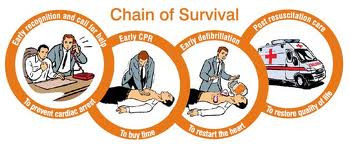
There are four key interventions that, when combined, dramatically improve survival. This is known as the Chain of Survival:
| Link | Intervention |
|---|---|
| A | Early access — call 000 immediately to activate the emergency response system |
| B | Early CPR — effective chest compressions to maintain circulation to the brain and heart while help is on the way |
| C | Early defibrillation — delivering a shock to treat the shockable rhythms that cause most cardiac arrests. Survival rates can reach 60–80% when defibrillation is delivered early |
| D | Early Advanced Life Support — paramedic and hospital care. This is where the ambulance comes in — but by this point, the first three links must already be in place |
What a Bystander With an AED Can Do
Defibrillators have been safely and successfully used by airline flight crews, security guards, police officers, fire fighters, first aiders, community responders and ordinary members of the public. They are designed for exactly this purpose.
All AEDs stocked by the Defibshop guide you from the moment you turn the device on — attach pads, analyse, shock if required, perform CPR. You are directly providing two of the four links in the Chain of Survival while the ambulance is on its way. Paramedics know that early defibrillation makes their job far more likely to succeed.
One important reassurance: ambulance and public access defibrillators are fully compatible. When paramedics arrive, they will either continue using the AED already in place or switch to their own unit. Either way, care is seamless and uninterrupted.
Don’t wait for an ambulance to be the first line of defence.
Talk to our paramedic team about getting an AED into your workplace, school or community.
Defibshop — makes saving lives easy!
Australia’s No.1 Defibrillator Store